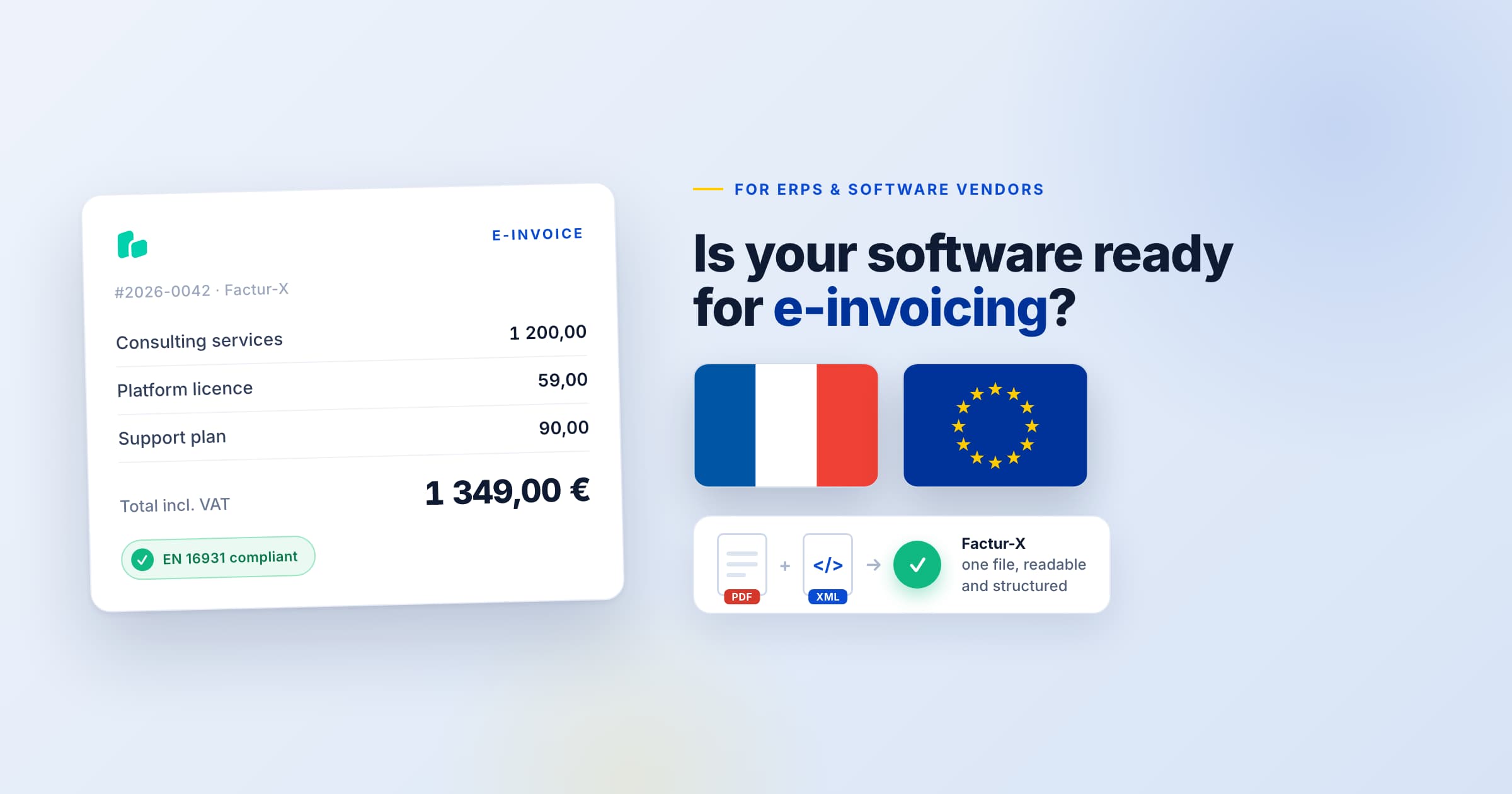
Since 1 September 2026, electronic invoicing is no longer a plan but an obligation in France, and other countries are on the same path. If you build software, an ERP, or a SaaS product used by businesses, your customers are asking a simple question: is your software compliant? You have two options. Build the compliance layer yourself, or run it on infrastructure that already exists and offer it to your customers under your own brand. This article is about the second option.

What the mandate requires, in France and next door
Since 1 September 2026, every French business registered for VAT must be able to receive structured electronic invoices, and large and medium businesses must issue them. Smaller businesses follow on 1 September 2027. A compliant invoice here means structured data that follows the EN 16931 model, most often delivered as Factur-X, the hybrid format that carries a readable PDF together with an embedded XML file. The same direction holds across the region. Germany uses XRechnung and ZUGFeRD, Belgium builds on Peppol BIS Billing 3.0, Poland runs KSeF, and the list keeps growing, so a vendor serving more than one country needs all of these, not a single format.
The infrastructure we provide
You do not have to become an expert in national invoice schemas to keep your product compliant. We run that part with our e-invoice API.
- A compliance layer. Your customers send clean JSON, and the API returns a validated file in the right national format. EN 16931, XRechnung, and Factur-X each have their own endpoint, with JSON to XML transformation, schema validation, and UBL and CII support inside.
- An embeddable editor. The template editor can live inside your product, scoped to each customer’s own workspace, so their people design and adjust their invoice templates themselves, without a ticket to your developers.
- Generation at scale. The same API produces the finished documents, from one invoice to a batch of thousands.
- Your brand on all of it. The editor and the output carry your styling, not ours.
Data residency, which matters most in Europe
You can run on a dedicated deployment in the EU region, so your customers’ data is processed inside the jurisdiction they require. One bank customer needed all processing to stay inside the European Economic Area, and a dedicated EU deployment met that requirement. The platform is ISO/IEC 27001:2022 certified, GDPR compliant, and HIPAA compliant. For partners who need full control, the platform can also run on premises.
How partners work with us
Through the partner program you resell or embed the platform and keep the customer relationship. We keep the standards current as each country’s rules move, so your roadmap does not fill up with schema maintenance and your team stays focused on the market you know. The mandate is already live in France, and the same requirement is arriving in the countries around it.
Want to offer this to your customers? Sign up and start right away, book a meeting with Michal to walk through the partner program and a dedicated EU deployment, or read the guide to generating compliant invoices.