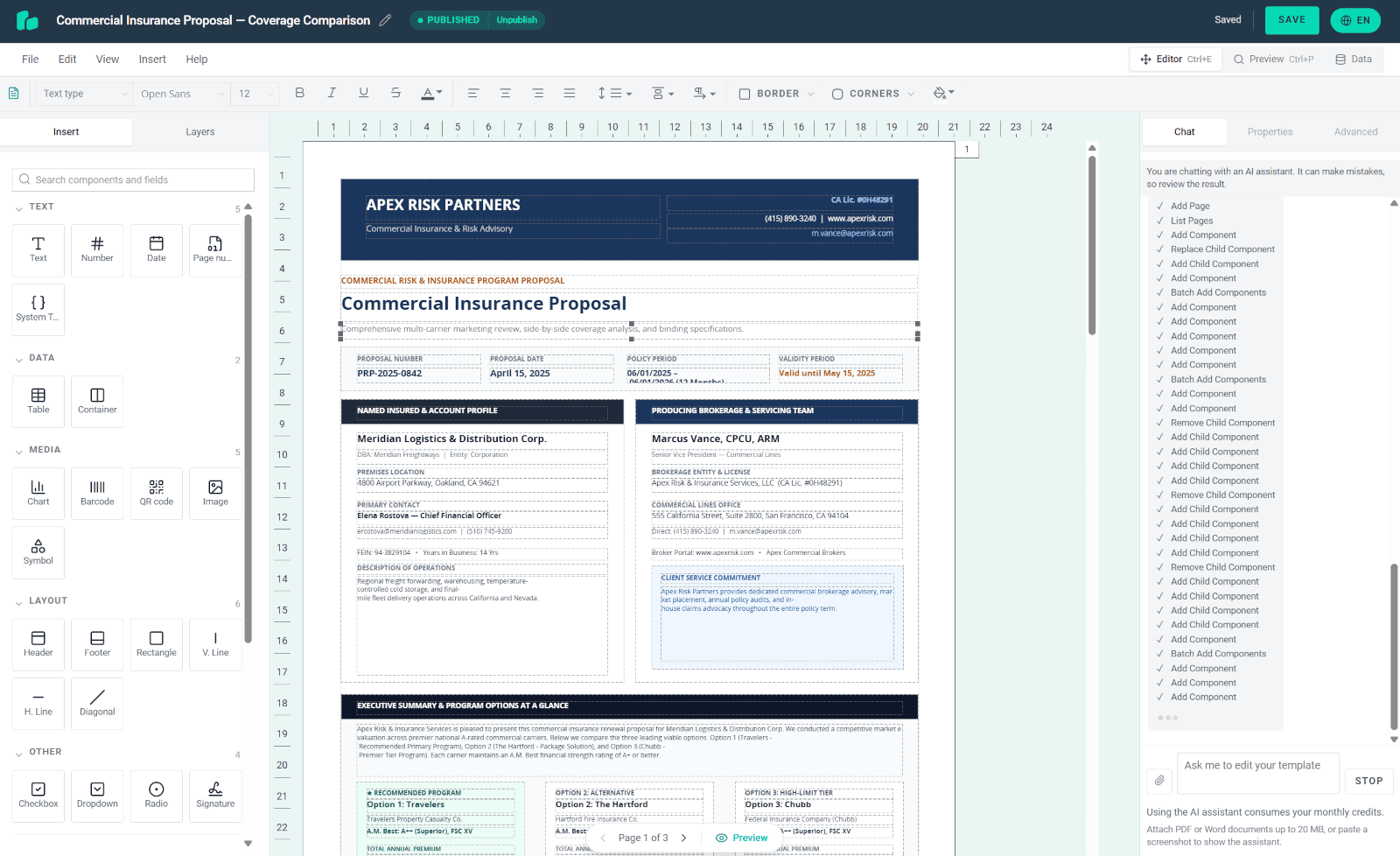
Coverage, limits, deductibles and premiums for two or more carriers, side by side. The table follows the payload, so a third option adds a column and a client with no vehicles drops the auto row.
PDF Generator API
Quotes, proposals, policy documents and certificates generated from your data
Generate quotes, proposals, policy documents, certificates and evidence of insurance, endorsements and renewal notices from the data already in your system. Your agents adjust the templates themselves, in a browser, without waiting for a release. ISO 27001:2022 certified, GDPR compliant, with dedicated deployment in the US, Germany, the UK or Australia, or on premises.
Quotes and proposals with coverage, deductibles and policy comparisons
Certificates of insurance and evidence of insurance on demand
No Credit Card Required for Your Free Trial



1,500+
companies trust us
6M+
documents generated monthly
4.5★
Information security
Trusted by teams featured in our case studies


What insurance teams generate with it
Insurance runs on documents that are almost identical and never quite the same. A certificate for one property manager needs their wording; a proposal for this client needs three options instead of two; a claim letter needs the adjuster's name on it. These are the ones teams generate here, from data they already hold. Every one of these comes from the same template set and the same API. There is no separate tool for the proposal and the claim letter.
Quotes and proposals
Applications and submissions
Pre-filled from what you already know about the account, with the gaps completed in a web form and returned as a finished document rather than a thread.
Certificates and evidence of insurance
Generated on request from current policy data, in the broker’s own branding, at the moment a property manager or lender asks for it.
Endorsements and renewal notices
Mid-term changes and renewal packs from the same templates. The version that was issued stays on record, so you can see what the insured was actually sent.
First notice of loss
A web form asks the questions in the order the adjuster needs them, takes the damage photos with the submission, and produces the notice as a document.
Claim correspondence
Acknowledgements, status letters, settlement offers and denials, each pulling from the claim record so the reference numbers and dates are right without anyone typing them.
Your agents change the wording, not your developers
A clause changes, a state adds a disclosure, a carrier updates its wording. None of that should wait for a release. Your agents and compliance staff edit the template in a browser, preview the output, and promote the version when it is signed off. Developers keep the integration; the people who own the words own the document.
- Drag and drop editing, no coding
- Every change versioned, so you can see what a document looked like when it was issued
- Production runs the version you promote, so editing never changes documents already going out
Where your policyholder data is processed
Shared cloud runs in the US. Dedicated deployment runs in the region you choose, which is how brokers and carriers meet a requirement to keep policyholder data inside the EEA. On premises runs inside your own infrastructure, with AWS as the only remaining sub-processor. Whichever you pick, we do not store the data you send or the document we generate.
- Dedicated deployment in Virginia, Frankfurt, London or Sydney, or on premises
- No payload and no generated document retained, and no payload contents in logs
- ISO 27001:2022 certified, audited annually, GDPR compliant, DPA and SLA available

The documents your policyholders actually see
A policyholder judges you on the proposal, the certificate and the letter that lands after a claim. Each one carries the broker’s logo and contact details rather than ours, generates at the moment it is asked for rather than overnight, and reaches the customer through the portal or the email flow you already run.
- White-label output, so every brokerage on your platform sends its own document
- Generated on request from live policy data, not a nightly batch
- Delivered through your portal, your email or your claims system via callback

First notice of loss, straight into a document
A claim starts with someone describing what happened, usually badly, over email or on the phone. A web form puts the questions in a fixed order, takes the photos with them, and produces the loss notice as a finished document instead of a thread someone has to summarise later.
Photos with the claim. File uploads arrive attached to the submission, so damage photos come in with the notice rather than in a separate email.
Pre-filled where you already know the answer. Policy number, named insured, coverage and effective dates come from your system. The claimant fills in only what you cannot.
A fixed set of questions. The form asks what the adjuster needs, in order, so the notice arrives complete instead of coming back twice for missing detail.
Straight into your claims system. A callback URL pushes the structured data and the generated document wherever the claim is handled.
New business and renewals too. The same forms take applications and renewal questionnaires, pre-filled from the expiring policy.
Built without a developer. Operations staff change the questions themselves when a line of business needs different ones.
Commercial brokerage · San Diego
From price calculator to signed evidence of insurance
Ives Insurance Brokers writes commercial property and casualty, liability and workers’ compensation for institutional property managers. They wanted a price calculator that ends in a document, not a spreadsheet that ends in a rekeying exercise. They built it on their own site with the Wix Velo integration, and have run it since 2022.
1
Quote
The agent picks the coverage. The template pulls property and liability coverage, deductibles and policy comparisons straight out of the existing database.
2
Proposal
Open text fields cover what no calculator can. The proposal generates from the same data and goes to the customer as a finished document.
3
Approval
The customer responds to the proposal they were sent, not a revised copy that nobody can trace back to a quote.
4
Evidence of insurance
Once it is approved, the agent generates the final evidence document from the same data. Nothing is entered twice.
Built with the Wix Velo low-code integration, not a development project
A brokerage founded in 1966, running it without an in-house engineering team
Built for insurance documents
Key Features for Insurance Services
Insurance documents are the same shape every time and different in every detail. A certificate is a certificate until the property manager needs their own wording, and a proposal is standard until this client wants three coverage options side by side. These are the parts that handle that: templates your own people change, documents generated from data you already hold, and a deployment your compliance team signs off.
Templates per line of business. Separate layouts for property, liability, auto and workers' compensation, each editable without touching the others.
Certificates and evidence on demand. Generate a certificate or evidence of insurance from current policy data at the moment someone asks for it.
Zapier, Airtable, make.com and other integrations are available for you to implement the service without any coding.
Endorsements and renewal notices. Mid-term changes and renewal packs pulled from the same templates, with the version that was issued kept on record.
Agents edit, developers do not. Wording and layout changes go live through the template workflow instead of the next release.
ISO 27001 certified, deployed your way. Dedicated deployment in the US, Germany, the UK or Australia, or on premises inside your own environment.
Security & deployment
Compliant out of the box, deployed your way
Every cloud plan is ISO 27001 certified and GDPR ready from day one.

Information security

Protected health data

AWS EU US Data Privacy Framework
Dedicated & on premises
Prefer your own infrastructure?
Same platform, more control. Pick a dedicated deployment close to your users, or install on premises inside your own environment.
 Virginia
 United StatesReach out →London
 United KingdomReach out →Frankfurt
 GermanyReach out →Sydney
 AustraliaReach out →
See our Terms of Service and cloud pricing.
Bring the document you argue about most
Michal is our pre-sales engineer. The useful version of this call is not a demo of the editor — it is you sending him a proposal, a certificate or a claim letter you produce today, and him rebuilding it as a template while you watch. That answers the question you actually have, which is whether your documents work here.

Questions we get
Before you talk to your security team
Can our agents change a template without a developer?
Yes. Templates are edited in a browser with drag and drop. Also a full HTML to PDF conversion API is available when a developer needs it. Each change creates a version, and the version you promote is the one production uses, so editing a template never changes a document already going out.
What if a proposal needs three carrier options instead of two?
The layout follows the data. A third option adds a column, and a client with no vehicles drops the auto row. One template covers every combination rather than one template per permutation.
Where is our policyholder data processed?
Shared cloud runs in the US. Dedicated deployment runs in the region you choose: the US, Germany, the UK or Australia. On premises runs inside your own infrastructure.
Do you store the documents we generate?
No. We do not store the data you send or the document produced from it, and log files never contain your payload. What stays with us is the template structure and any static content you put in it.
Do you support ACORD forms?
Not as ready-made templates, because ACORD forms are licensed to ACORD members. We build proposals, certificates, evidence of insurance and claims documents in your own layout. If you hold an ACORD licence and need those specific forms, talk to us.
Can a policyholder complete a form and have the document generated from it?
Yes. Web forms collect the answers and any photos, pre-fill what you already know from your system, and a callback pushes the structured data and the finished document into your claims system.
Something your compliance review will ask that we have not answered here?