Introduction
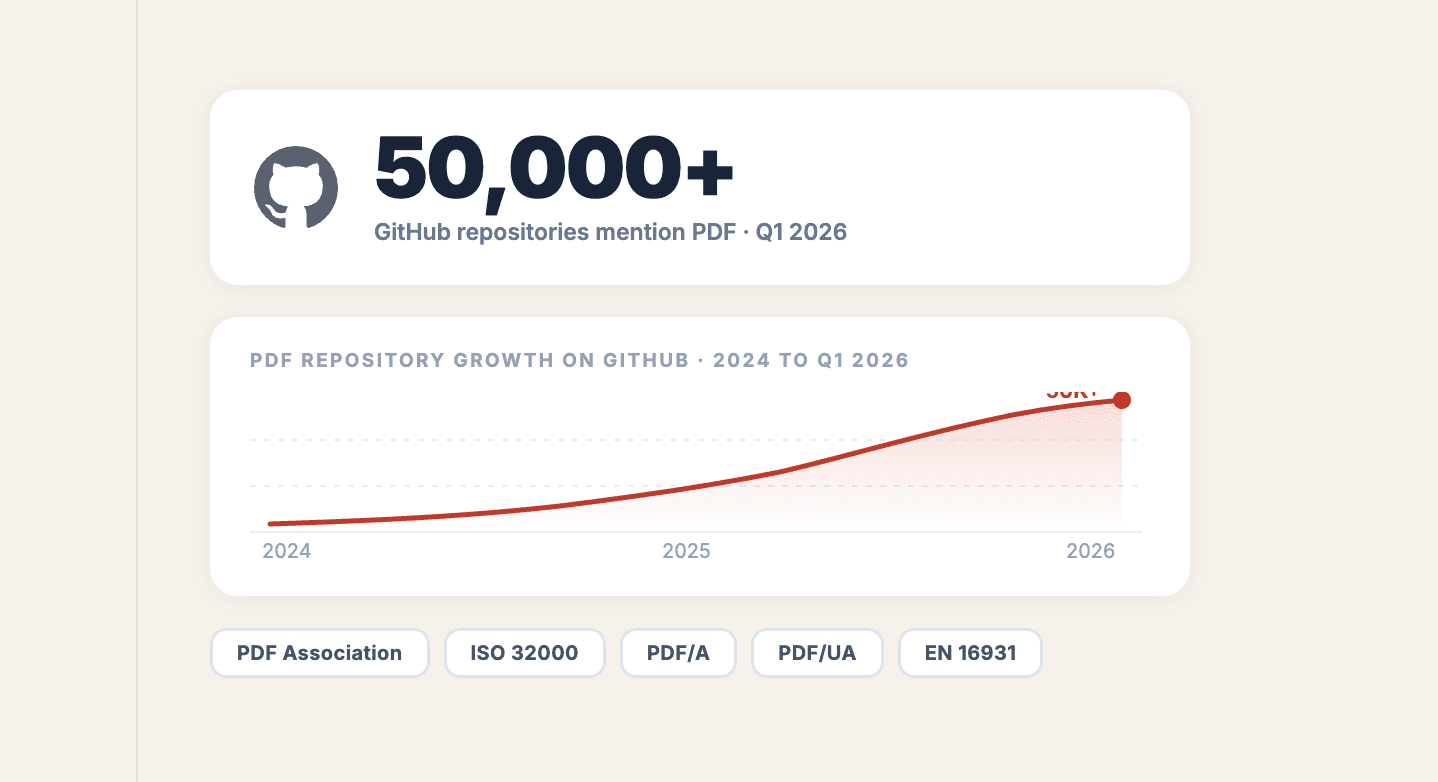
The PDF Association published a striking number this week: more than 50,000 GitHub repositories mention PDF in the first quarter of 2026 alone, with growth rising sharply since mid 2024.
That is not a typo. PDF, a format that has been around since 1993, is one of the most actively developed file formats on GitHub right now. For any team running document generation workflows or evaluating an HTML to PDF API, the trend is impossible to ignore.
If you build document workflows, this matters. Here is what is happening, and what it means for engineering teams picking PDF tooling in 2026.
Three signals from the last 30 days
The PDF Association article highlighted three releases that capture where the energy is going.
veraPDF 1.30 shipped on April 22 from the Open Preservation Foundation. veraPDF is the reference validator for PDF/A archival profiles. Continued releases mean teams archiving documents at scale can rely on it for compliance checks.
Mozilla Firefox v150 added page duplication, deletion, and export to its built in PDF editor. Browser native PDF editing is no longer a workaround. It is a default user expectation, and any product that renders PDFs through an API now competes against what users see in their browser.
Mustang Project v2.23.0 is an open source Java tool for generating compliant electronic invoices. It supports ZUGFeRD and Factur X hybrid formats. As European invoicing mandates land in 2026 and 2027, tools like this are becoming load bearing in enterprise stacks.
Three different problems. Three active open source ecosystems. All released in the same month.
Why now: three drivers behind the PDF API surge
1. AI is generating documents at scale.
LLMs produce text. Enterprises ship that text as PDF. Every chatbot that emails a quote, every research agent that exports a report, every internal tool that summarizes a meeting, ends up rendering a PDF somewhere, usually through an HTML to PDF API or a document generation API. The PDF Association curve bends up around mid 2024, the same window when production AI workloads exploded. The two trend lines are not coincidence.
2. Electronic invoicing mandates in Europe.
Germany moved to mandatory B2B electronic invoicing in 2025. France and Belgium follow in 2026. Poland’s KSeF is coming. Each mandate expects PDF/A 3 with embedded structured XML, or pure UBL and CII output. Teams that ship invoices are scrambling for tooling that respects EN 16931. PDF generation is no longer just about layout, it is about regulatory output.
3. Standards maturation.
ISO 32000 part 2 (PDF 2.0), ISO 19005 (the PDF/A family), and the PDF/UA accessibility profiles are no longer aspirational. Auditors check them. Enterprise procurement asks for them. Compliance now requires picking tooling that respects them, not improvising with HTML to image hacks or homegrown Puppeteer scripts.
What this means for HTML to PDF API selection
If your stack produces more than a few hundred PDFs a month, or any PDFs that touch regulated workflows (healthcare, financial services, public sector, accessibility), three things are now required, not optional:
- Validated output against PDF/A or PDF 2.0
- Structured electronic invoice support for at minimum EN 16931, UBL, CII, XRechnung, Factur X, and ZUGFeRD
- Accessibility tagging consistent with PDF/UA
Building this in house is a multi quarter engineering effort. The tradeoff between PDF API vs Puppeteer (or wkhtmltopdf, or any other DIY route) used to be a cost question. In 2026 it is a compliance question. The PDF Association article exists because thousands of teams are realizing this and choosing between building or buying.
A document generation API that does not ship PDF/A and EN 16931 today will not be on procurement shortlists tomorrow.
Where Actual Reports stands
We are a PDF Association member. PDF Generator API is built around the same standards that matter on GitHub right now.

- PDF 2.0 compliant output
- EN 16931, UBL, CII, XRechnung, Factur X, and ZUGFeRD support today
- ISO/IEC 27001:2022, HIPAA, and GDPR compliance
- Drag and drop template editor that lets your end users manage their own templates without touching code
- OpenAPI v3 with SDKs in PHP, Java, Ruby, Python, and JavaScript
Over 1,000 paying customers across healthcare, ecommerce, financial services, insurance, logistics, legal, HR, sales, real estate, and procurement run their document workflows on PDF Generator API.
If you are evaluating a PDF API with a visual editor, multi tenant template management, or first class Node.js PDF generation support, the standards you are quietly betting on matter as much as the rendering speed.
The takeaway
PDF is one of the most actively developed open standards on GitHub in 2026, and the regulatory pressure behind it is only growing.
If you are still treating PDF generation as a side concern, the gap between teams that picked the right HTML to PDF API and teams improvising will widen sharply across this year.
Try PDF Generator API for free here.
Source: PDF is Trending on GitHub, PDF Association, April 27, 2026.