Most document automation tools were built for the Latin alphabet, and in Japan, that shows up on the first page you generate. Giko Co., Ltd., a dental laboratory and medical device manufacturer that produces crowns, dentures, and clear aligners, has generated its lab order forms and receipts with the PDF Generator API since 2021. Ken Kanazawa, who runs business development and systems at Giko, picked it through the Make.com integration after testing the PDF modules available at the time. It was the only one that printed Japanese characters correctly.
Who Giko is
Giko manufactures dental prosthetics for dentists across Japan. The workflow is digital end to end: the dentist takes an impression with an intraoral scanner, the scan file goes to the lab, and the lab designs and mills or prints the crown or denture on a CAD/CAM system. Two years ago, the Japanese government added this scanner-based workflow to publicly reimbursed treatment, and dentists quickly adopted it.
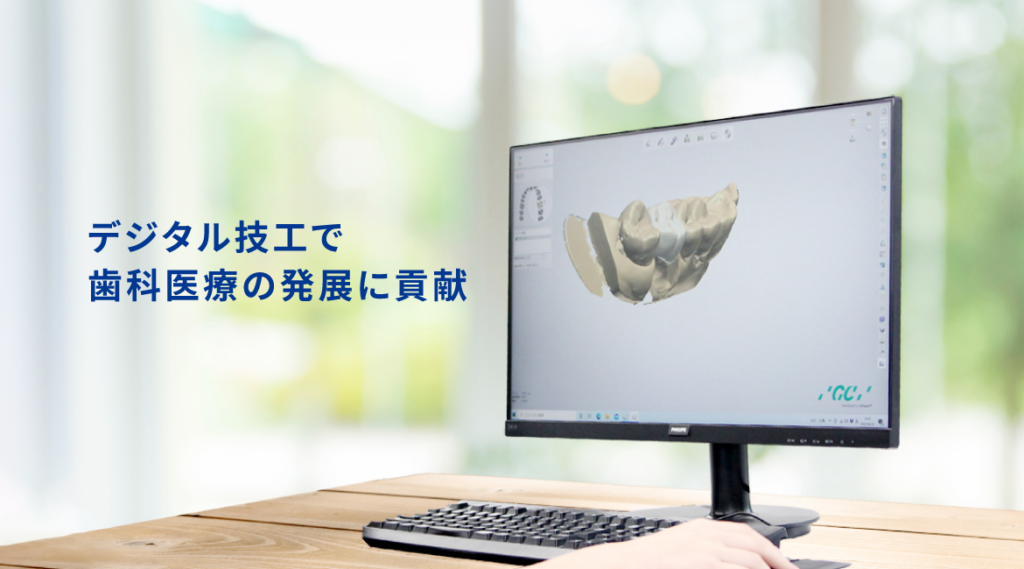
The lab’s problem is that each scanner vendor runs its own cloud portal, and dentists choose the scanner. Each new case lands in one of several vendor portals, with the scan data and the instructions for what to make.
“What the dental lab should do is to check all the clouds that all the vendors provided, look in all those clouds and get all the scan data, and what should we make. In each case we should bring it from all those clouds.”
Five years ago, Ken built an automated polling and RPA system that pulls every case out of every vendor portal into one internal database. Lab technicians work from that database and never open a vendor portal. Every case also needs a document: a lab order form that travels with the job and a receipt for the dentist’s order.
The challenge: a PDF module that can print a Japanese name
The orchestration ran on Make.com, which Ken had used for home automation for seven or eight years. When he searched the Make.com marketplace for a PDF module, he wasn’t looking for layout or speed.
“I just searched what kind of PDF module can handle it, and I found two or three products, tried it, tested, and found yours was the best. That was four or five years ago. Your product was the only one which can use Japanese characters at that time.”
Japanese PDF SaaS products existed, but none had a Make.com module, and Make.com had no presence in Japan to make those connections. A tool that printed Japanese characters and had a Make.com module was a one-of-a-kind.
The detail peer vendors miss is where Japanese text actually breaks. Running text in a standard CJK font renders fine. Personal names do not. Japanese family names carry kanji variants with centuries of history, and families have deliberately altered characters to be distinct.
“Normal sentences, most of the fonts can support. But especially on the name for the people, it’s so complicated. Some of the people want to be different from the other people, so they arranged their characters in the past, and it’s still going on.”
A lab order form names the dentist and the patient on every page. If a character is missing from the embedded font, it renders as a blank box, and the document goes out wrong on the one field that identifies the case. Name rendering is a data quality problem for a lab, not a cosmetic one.
The solution: one document layer behind the RPA system
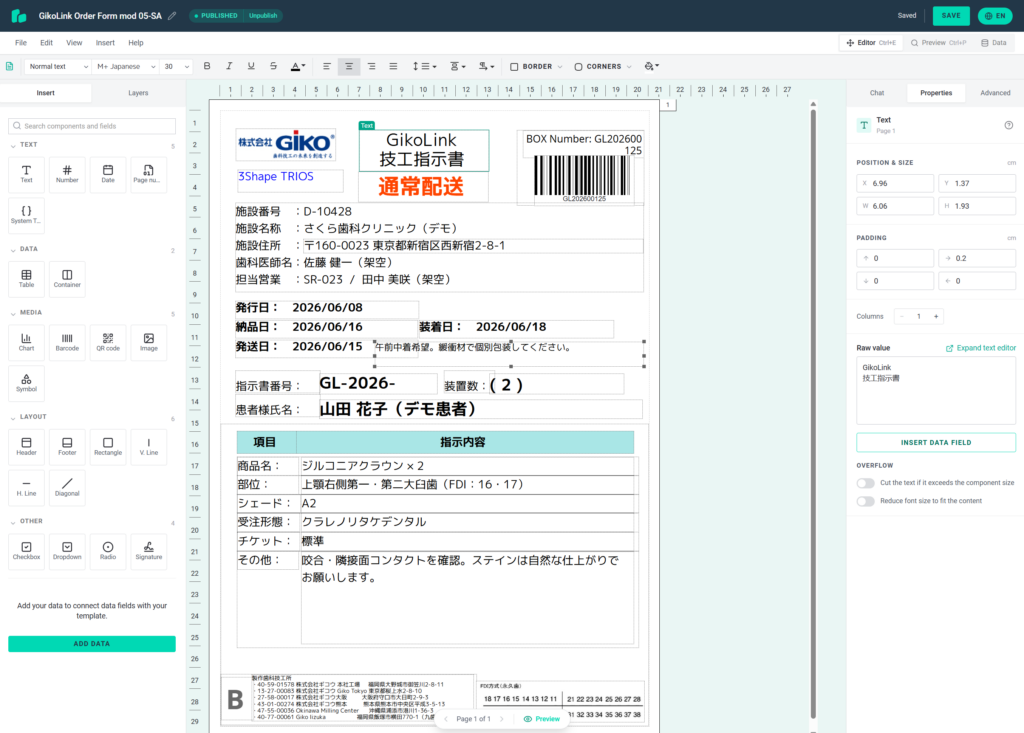
Giko’s Make.com scenarios take each consolidated case record and call the PDF Generator API to merge it into the GikoLink order form template. The template holds the customer number, clinic name and address, dentist, sales rep, order number, technician, patient name and the product specification table (product, region, shade, type, size). The issue, delivery, shipping, and appointment dates come from the same record.
Ken built the templates himself in the drag-and-drop editor. The layout follows the paper form the lab used before, because Japanese business documents keep their format regardless of medium.
“The format itself will remain, because it’s a long cultural thing. I believe those kinds of documents, especially in Japan, will not go away. The format will remain, although they print it or not. In the PDF format they will keep it.”
Giko didn’t have to build a font pipeline, a layout engine that handles vertical spacing in Japanese text, or a PDF library that embeds CJK fonts correctly. Those were the parts that stopped the other modules from working.
Font coverage, five years in
Giko’s use surfaced characters that even the editor’s broad Japanese fonts didn’t cover. The fix went in on both sides of the product in the weeks before this conversation:
- Noto Sans JP and the IPAmj Mincho font, which covers the full set of legacy name variants the Japanese government maintains, are now available as template fonts.
- Fallback fonts: a template can declare a secondary font, so if the primary font lacks a character, that component renders in the fallback instead of a blank box.
- Font subsetting, enabled in template settings, embeds only the characters actually used in the document. CJK fonts are large, and embedding a full one makes every PDF large. Subsetting trades a small increase in generation time for a much smaller file.
The impact: five years of forms, and a layer that outlasts the tooling
The RPA system and its document output have run in production at Giko since 2021. Every case that enters the lab gets its order form and receipt from the same template layer, without a technician touching a vendor portal or a document.
Ken said that if the system were renewed, he would build it with AI-assisted development rather than Make.com, and that the document layer would remain.
“PDF is the standard way. Every environment, they can see it or create it. So I think with the creation of the PDF file, that kind of function will remain.”
For a software vendor, that is the useful lesson from Giko. Orchestration tools come and go. The template, the API, and the font coverage are the parts that don’t need to change with them.
What a Japanese document workflow actually requires
Giko chose the PDF Generator API in 2021 because it was the only Make.com module that could print Japanese characters. Five years later, the requirement hasn’t changed: the layout has to match the paper form, and every name has to render, including those no standard font covers. The templates Ken built then still produce every order form the lab ships, and they’ll keep doing so no matter what runs the orchestration around them.